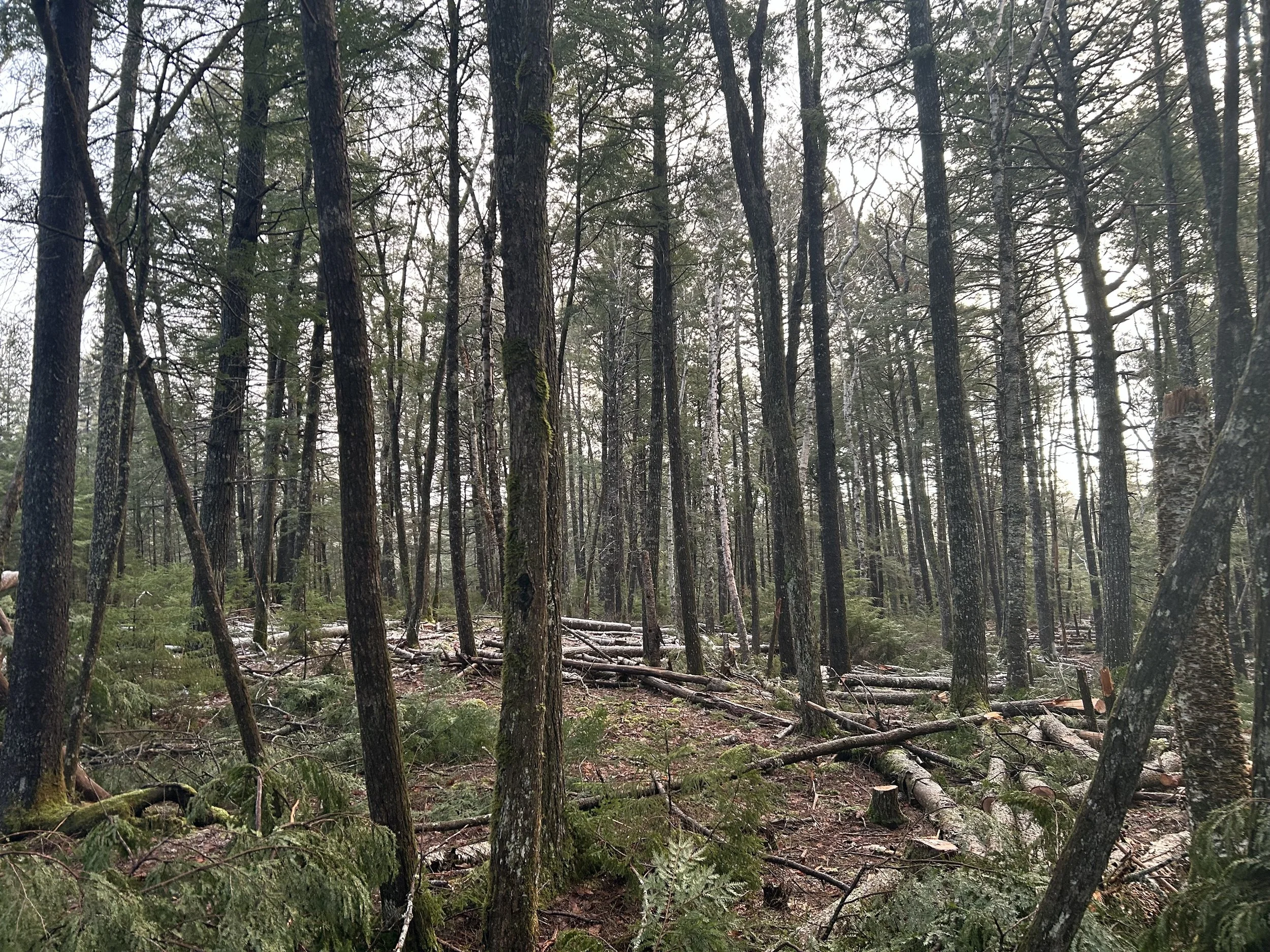
This webinar will focus on silviculture strategies that help woodland stewards prepare for, and adapt to, the arrival of Hemlock Woolly Adelgid (HWA). Practices such as stand thinning can improve tree vigour in advance of infestation. Silviculture can also play a mitigative role in cases where insecticide treatments are feasible, where the focus is on promoting species and structural diversity.
Presenters Matt Miller, Michael Stastny and James Steenberg will share practical guidance informed by ongoing research and on-the-ground management experience. Woodland stewards will gain clear considerations and proactive steps to help conserve and strengthen hemlock stands before and after HWA establishment, supporting long-term forest resilience and ecological health.
This webinar is part of a three-part series designed to equip woodland stewards with practical, research-informed tools for responding to Hemlock Woolly Adelgid (HWA), an invasive, aphid-like insect that has been devastating hemlock forests in Nova Scotia since its discovery in 2017. Follow the links below to register for parts 1 and 2.
Webinar 1: Chemical Treatment Options and Resources for Woodland Stewards (February 26th)
Webinar 2: Understanding Biological Control and Research in Nova Scotia (March 5th)
Presenter Bios
Matt Miller
Matt Miller began working with MCFC as the Operations Manager in November 2021. An avid outdoors person and maple syrup aficionado originally hailing from Pictou County, Nova Scotia, Matt graduated from the Maritime College of Forest Technology and University of New Brunswick. Working under the guidance of the ED & Board, Matt is responsible for the planning, implementation, and supervision of forest management activities on MCFC lands, as well as management of MCFC's HWA Program.
Michael Stastny
Michael Stastny is a Forest Insect Ecologist with the Canadian Forest Service at the Atlantic Forestry Centre in Fredericton NB. With a broad background in community ecology, his research examines the outcomes of interactions between insects and their environment. Studying both native and invasive insects on trees, his work focuses on their ecological effects on forest ecosystems, and on strategies to control insect pest populations or mitigate their impacts.
James Steenberg
James Steenberg is a Senior Research and Planning Forester with the Nova Scotia Department of Natural Resources, where he is responsible for the Department’s research on silviculture, climate change, and forest carbon. He has a PhD in environmental science, is an honorary research associate at UNB’s Faculty of Forestry and Environmental Management, and an adjunct professor at Dalhousie University, where he teaches and recently completed a Killam Postdoctoral Fellowship. He was also a Fulbright scholar at the United States Forest Service. James has over 15 years of research experience as a government scientist, consultant, and academic researcher focusing on forests.